
How to Check Criminal History in Boonville
Start with the record maker. The Boonville Police Department is the first contact for a city incident report or arrest report. A report describes what officers recorded, but it is not the same as a court judgment. The Cooper County Detention Center can confirm a county booking, while Missouri Case.net shows a prosecution only after a charge is filed. MACHS, operated by the Missouri State Highway Patrol, is the separate statewide criminal-history channel.
Use enough detail to avoid a Boonville name-only mix-up. A Boonville report number is best. If that is not known, gather the event date, approximate time, place, and involved party name. A Boonville court case number serves the same role for a docket request. Boonville criminal records can sit in several systems because each custodian records a different stage.
- Ask Boonville Police whether it holds the incident or arrest report.
- Submit the police Sunshine request form with precise event details.
- Check whether a city ordinance matter is in Municipal Division 18 or Cooper Division III.
- Call Cooper Detention for booking or release information, then search Case.net for filed charges.
- Use MACHS when the question calls for a Missouri statewide criminal-history record.
Boonville Police Records at East Morgan
Boonville publishes an unusually clear police records route. Boonville Police is at 401 East Morgan Street, with the main line at 660-882-2727 and fax at 660-882-6604. The Boonville department operates at all hours, but its records counter is posted for 8:00 a.m. to 5:00 p.m. on weekdays. Those are different facts: round-the-clock Boonville police service does not mean a records clerk is available at all hours.
The official Boonville public-safety page also identifies 21 sworn and seven non-sworn personnel. Its investigation unit submits evidence to the MSHP Crime Lab and participates in the regional Mustang Drug Task Force. That can create more than one report trail. Ask which agency is the custodian rather than assuming every record stays with Boonville.
The city’s public-safety source shows where local police record requests begin.
The page ties a Boonville report request to the department that created the local record.
The Boonville Police Department
Chief Randy Ayers is listed by Boonville as the police contact. The Boonville department keeps incident and arrest reports created by its officers, along with related records that may be open in whole or in part. A requester should describe the exact material sought. “All criminal history” is too broad for a Boonville police file because Boonville does not hold every court, jail, or statewide record tied to a person.
Missouri Sunshine Law can require the release of open portions while allowing closed portions to be withheld. Active investigative details, juvenile information, protected victim or witness data, and records closed by another law may not be released. If part of a Boonville police record is closed, ask the custodian to segregate and provide the open part. The request should also ask for the legal basis of any denial.
Boonville Police Department
401 East Morgan Street
Boonville, MO 65233
660-882-2727
Records counter: Monday-Friday, 8:00 a.m.-5:00 p.m.
Boonville Criminal Record Request Form
The Boonville forms directory links the Boonville police Sunshine request. It asks for a detailed record description, contact information, a preferred response, a cost ceiling, and a signature. Boonville event date, time, location, involved people, and the report identifier help staff find the right file. A requester may also ask for electronic delivery and for open parts to be separated from closed material.
The form states a ten-cent charge for standard letter-size pages and a $20 hourly research or file-pull rate. Other media may carry actual media and staff costs, and prepayment may be required. The form includes a fee-waiver claim and explanation, but a request does not guarantee that a waiver will be granted. Set a cost ceiling and ask for an estimate before work goes beyond it.
The official forms page displays the city’s route to a written Boonville criminal record request.
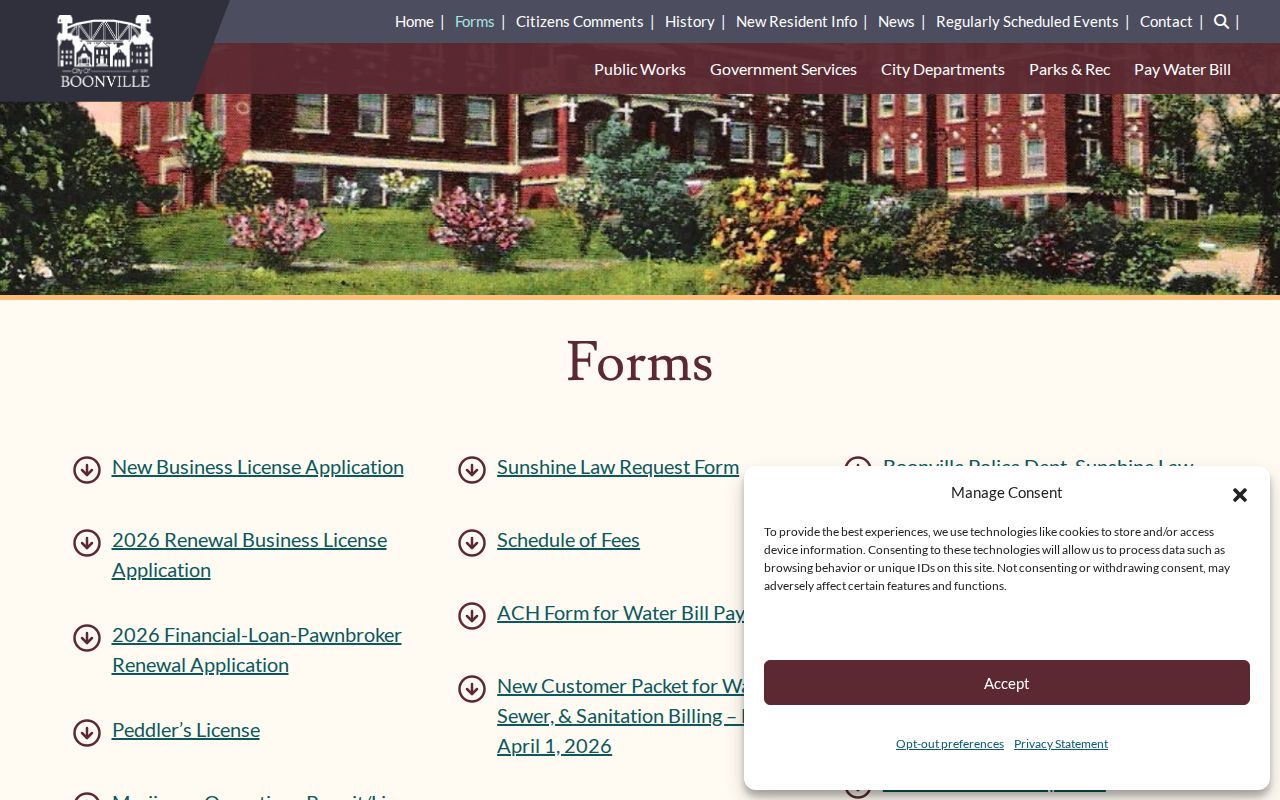
That written route is more precise than a broad verbal request and creates a record of what was sought.
| Request detail | Why it helps |
|---|---|
| Report or event details | Points staff to the correct Boonville police file |
| Preferred electronic format | May reduce copying and delivery work |
| Advance cost ceiling | Requires notice before costs exceed the chosen limit |
| Segregation request | Asks for open portions when another part is closed |
Note: The three-business-day rule usually governs a response or delay explanation, not guaranteed delivery of every large Boonville record request.
Arrests and Bookings in Boonville
A Boonville arrest starts at the police department, but custody data moves to the county level. No city jail roster or Boonville booking portal was found in the official sources. Call Cooper County Detention at 660-882-6985 to ask whether a person is held, transferred, or released. If a written booking record is needed, ask how to submit a Chapter 610 request and what identifying details the detention office requires.
Then check Missouri Case.net for a filed Boonville charge. A recent Boonville police arrest may not yet appear there, and an arrest may never produce a filed case. For statewide open criminal-history information, MACHS is a third channel. A Boonville report, county booking, Case.net docket, and MACHS response must not be treated as copies of one another.
The full county fallback chain and the difference between arrest and conviction are covered in Cooper County arrest history.
Boonville Task Force Record Trails
Boonville Police reports participation in the Mustang Drug Task Force, whose work can cross Boone, Callaway, Cole, and Cooper counties. A Boonville stop or investigation can therefore involve Boonville officers, task-force personnel, MSHP evidence work, a county prosecutor, and a court clerk. The place where a Boonville event happened does not always identify the office that controls every resulting record.
When the custodian is unclear, begin with the agency named on the report, citation, property receipt, or court docket. Ask whether another agency produced a supplemental report. For a filed Cooper County state charge, the court record still belongs with the Circuit Clerk even if several agencies helped investigate. This division of custody prevents a single request from reaching every related record by default.
Quick distinction: Boonville Police holds its agency reports, Cooper County Detention holds county booking data, and the Circuit Clerk holds filed court records.
Boonville Municipal Court Records
The 18th Judicial Circuit rules identify Boonville Municipal Division 18 and allow a Municipal Traffic Violations Bureau under section 479.050. Yet a division number alone does not prove where today’s file sits. Municipalities that do not maintain a current municipal court may transfer matters to Cooper Division III. Confirm the present route with the City Clerk or Circuit Clerk before requesting a non-remote file.
Search Case.net by litigant name, filing date, case number, or scheduled hearing. Choose Cooper County where the screen allows. A name search can miss a protected party or a name that is not indexed as a litigant. When the exact number is known, a case-number search is more direct. Docket entries may be visible even when the filed document image is not available online.
| Court Name | Boonville Municipal Division 18, subject to current routing through Cooper Division III |
|---|---|
| Case Types Heard | City ordinance and traffic matters within municipal jurisdiction |
| Case Lookup Channel | Case.net, City Clerk confirmation, or Cooper Circuit Clerk |
| What the Docket Shows | Case number, status, parties, events, charges or violations, and disposition where public |
| Copies & Fees | Ask the current record holder for availability, format, certification, and cost |
Boonville Records and Three Business Days
Boonville says it will respond within three business days. If more time is needed, the city provides a reason and an estimated availability date within that period. This rule is often read as a promise that every record must arrive within three days. Large files, redaction work, archived material, and multi-agency questions can require more time.
Keep the written response. It should show whether the city has located the record, needs more time, expects charges, or claims a legal basis for closure. If Boonville does not hold the record, ask whether staff can identify the likely custodian. That answer may route a police request to Cooper County, the state patrol, or the court without turning the city clerk into a source for records it never created.
Where Boonville Records End Up
Each office adds a new layer. Boonville Police creates the local incident or arrest report. Cooper County Detention creates booking data when a person is received there. A municipal or county prosecutor chooses what to file. Once a charge is filed, the clerk creates the court case, and qualifying arrest and disposition data can reach the MSHP Central Repository.
Record flow: Boonville Police Department › Cooper County Courts › Missouri State Highway Patrol CJIS Central Repository
For the newest Boonville event, the police or detention contact may be the best first source. For a filed result, use Case.net and the clerk. For a statewide record tied to a possible name match, use MACHS. The broader Cooper County criminal history overview explains how those county and state layers differ.
Boonville City and County Records
Boonville City Hall is at 401 Main Street, while city police records begin at 401 East Morgan Street. The Cooper County Courthouse is at 200 Main Street. Those close addresses can be misleading because each counter serves a different custodian. The city clerk cannot replace the police records unit, and the county sheriff does not issue the Circuit Clerk’s court file.
The city’s official contact page lists City Hall, police, and clerk contacts.
The separate city contacts reinforce why a Boonville record search should begin with the exact kind of file, not merely the nearest building.
| Boonville question | Starting office | Record layer |
|---|---|---|
| What did city police record? | Boonville Police | Incident or arrest report |
| Where is a city ordinance file? | City Clerk or Circuit Clerk | Municipal or Division III docket |
| Was a person booked locally? | Cooper Detention | County custody record |
| What was filed and decided? | Case.net or Circuit Clerk | Court case file |
Missing Boonville Case.net Records
A name search in Case.net requires the person to be indexed as a litigant. Victims, witnesses, children, protected-order subjects, and other protected parties may be linked to a case without appearing in public name results. Spelling, a recent filing, a sealed case, and municipal routing can also explain why an expected Boonville criminal court record is absent.
Try the exact case number when it is known. Filing-date mode can narrow a known time period, while scheduled-hearing search can locate a public event. Select Cooper County rather than relying only on a Boonville label. If the public docket still does not resolve the question, call the Cooper Circuit Court Office at 660-882-2232. Staff can explain the public access channel for an older or non-remote file, though confidential and sealed material remains restricted.
Public Access Rules for Boonville Records
Missouri treats police records, court records, and Central Repository records under different access rules. Chapter 610 governs city and county public records. Court Operating Rule 2 governs access to judicial records. A public MACHS name response is limited to Missouri open-record categories and is not a copy of every Boonville file. Juvenile, sealed, confidential, protected-party, and active investigative material may be restricted.
Ask for a citation when material is withheld and request all open, reasonably segregable portions. A blank search result does not prove that no event occurred. Spelling, indexing, filing delay, a transferred municipal matter, or a lawful closure can each change what appears remotely.
Key Statutes:
Section 610.023 RSMo requires public bodies to identify records custodians and sets request-response duties.
Section 610.026 RSMo governs permitted copying and research charges.
Section 610.100 RSMo governs Missouri incident, investigative, and arrest records.